Laser dentistry in Hamilton: 7 questions to ask first
Lasers are tools, not a diagnosis
If a dentist suggests laser treatment, the first question is simple: what problem is the laser being used to treat? Dental lasers are tools, and different lasers are used for different jobs. The right answer depends on the tissue involved, the diagnosis, and the goal of care.
That is why a good laser discussion should never start with the device alone. It should start with your diagnosis, your choices, and the outcome you can realistically expect.
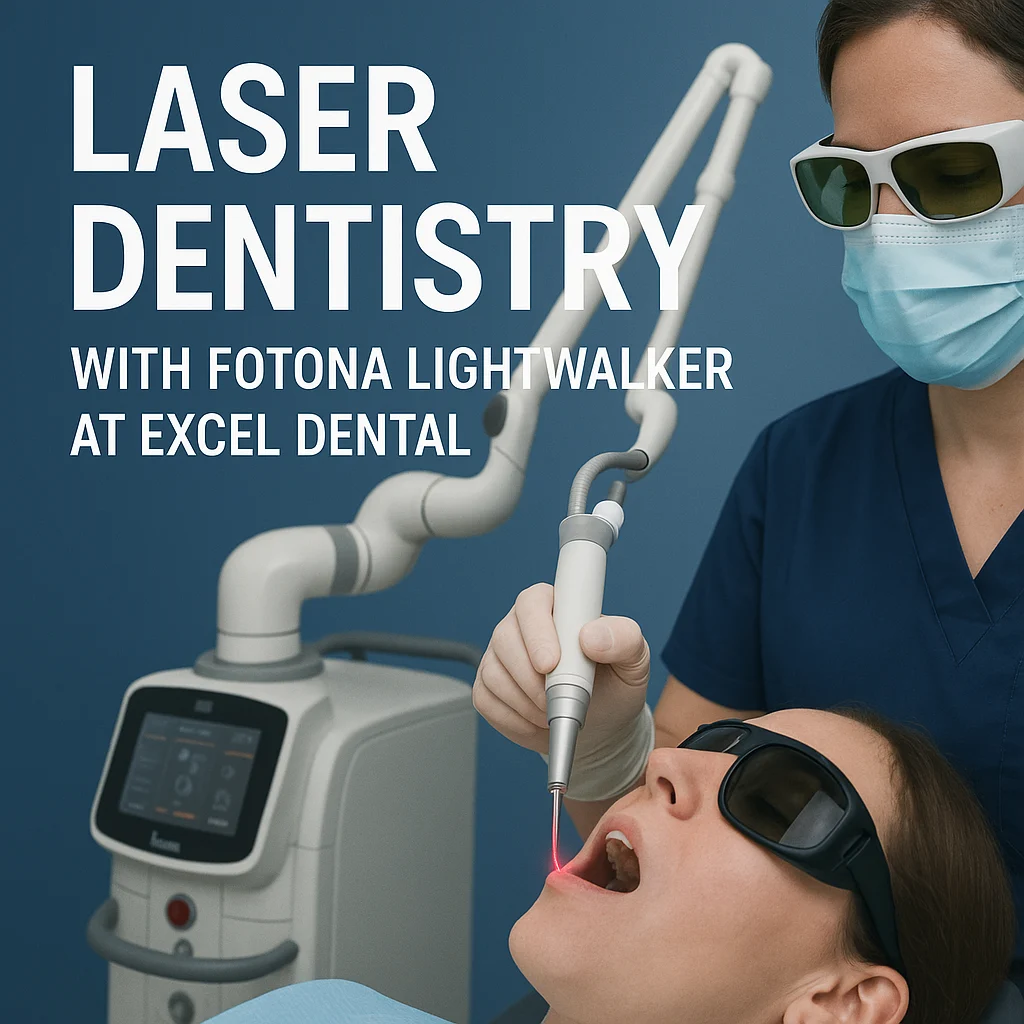
To see one example of how a laser may be used in a dental setting, you can review laser dentistry at Excel Dental.
Three laser uses patients may hear about
1) Soft-tissue laser procedures are used on gum and other soft tissues. In some cases, a laser may be used to cut or shape tissue during selected gum procedures or other soft-tissue surgery. The question is not whether a laser was used; it is whether it was the right tool for that tissue and diagnosis.
2) Hard-tissue laser use refers to tooth structure such as enamel or dentin. This is the area where patients should ask extra questions. Laser use on hard tissue has limits, and it is not automatically better for every cavity or tooth problem. In some cases, a conventional filling, crown, or another restorative approach may still be the most appropriate option.
3) Photobiomodulation, or PBM, is different from cutting or drilling. PBM uses nonthermal light, and it is usually meant to support healing, comfort, or inflammation control rather than replace treatment. Because PBM depends on dose, timing, wavelength, and protocol, outcomes can vary. It is a technique where training and the exact plan matter.
Questions to ask before you say yes
- What exactly is being treated? Ask for the diagnosis in plain language.
- Why is a laser appropriate here? Ask what the laser is expected to do that another option would not.
- What result should I expect? Ask about the likely benefit, the limits, and how success will be measured.
- What evidence supports this for my specific problem? A laser use can be reasonable in one situation and less useful in another.
- Is a conventional treatment also reasonable? For many conditions, there is more than one acceptable path.
- Who is doing the procedure, and what training do they have? Ask about experience with that exact laser and that exact procedure.
- What safety steps are used? Good laser care should include eye protection, correct settings, and a clear explanation of how the tissue will be protected.
What reassuring answers sound like
Helpful answers are specific. For example: “This laser is being used on soft tissue to treat a limited area,” or “This PBM treatment is being used as an adjunct, not as a replacement for the main treatment.”
Less reassuring answers are vague. If you hear “the laser is just better,” “it works for everything,” or “you will definitely need it,” pause and ask for more detail. A careful recommendation should match the tissue, the problem, and the expected outcome.
What the evidence suggests about limits
The Canadian Dental Association and the American Dental Association both emphasize that laser use should be indication-specific and based on training, competence, and safety. That matters because not all lasers do the same thing, and not all procedures have the same quality of evidence.
For PBM in particular, evidence is still mixed across uses. It may be helpful in some settings, but the protocol matters and it is usually adjunctive. For hard-tissue uses, available evidence also shows that parameters and outcomes matter. In plain language: the device is not the treatment plan.
If your explanation is still unclear, ask for a plain-language backup plan. In many cases, a conventional option remains a sensible choice, even if a laser is available.
A calm next step for Hamilton patients
If you are in Hamilton and trying to decide whether laser dentistry makes sense for your situation, bring your questions to an exam and consultation. At Excel Dental, we can help you compare the purpose of the laser, the expected benefit, and the alternatives so you can make an informed decision. If you prefer, you can start by asking what the laser is meant to do in your case and whether there is a non-laser option that would also be reasonable.
Key sources
- Canadian Dental Association Position on Lasers
- ADA Technical Report No. 133: Guide to Dental Lasers and Related Light-Based Technologies
- Effects of femtosecond laser on hard dental tissues: A scoping review
This article is for general education only and does not replace personalized advice, diagnosis, or treatment from a licensed dentist.