
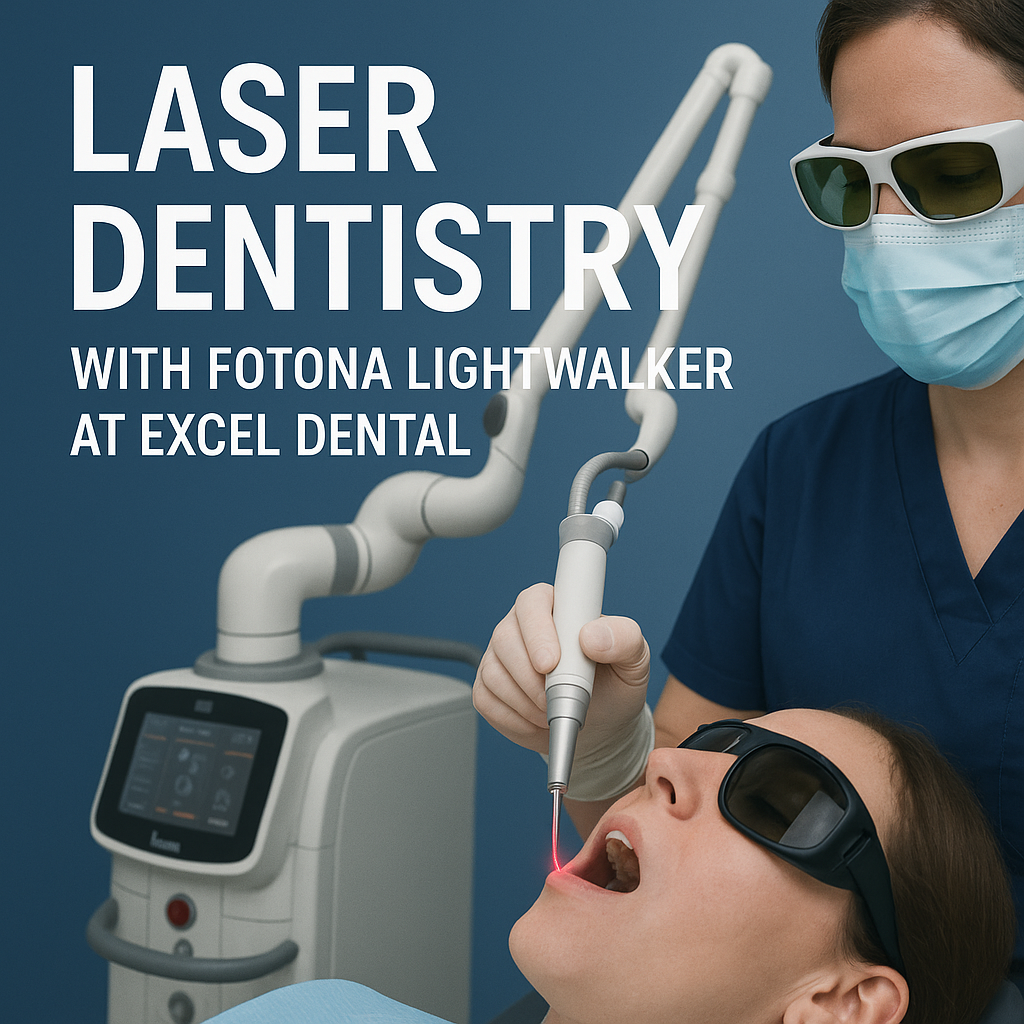
Fotona Laser Dentistry for Root Canals: What the Evidence Says About Comfort, Cleaning, and Limits
What patients mean when they ask about a Fotona laser root canal
When patients ask whether a Fotona laser can be used for a root canal, they are usually asking about one specific part of treatment: using an Er:YAG laser to activate the cleaning fluid inside the root canal.
That is an important distinction. A laser does not replace a root canal. Standard root canal care still depends on a careful diagnosis, shaping the canals with instruments, using disinfecting solutions, sealing the canal system well, and following the tooth over time.
In plain language, a Fotona laser may be used as an added tool during the cleaning phase. It is not a shortcut, and it is not a guarantee of a better result in every case.
How Er:YAG laser activated irrigation fits into a standard root canal
A root canal is done to treat infection or inflammation inside a tooth. After the dentist or endodontist reaches the inside of the tooth, the canals are cleaned with instruments and rinsed with disinfecting solutions. Because root canals can have tiny branches and irregular spaces, clinicians have looked for ways to help those fluids move more effectively.
This is where laser-activated irrigation comes in. Er:YAG refers to a type of laser with a wavelength that interacts strongly with water. In endodontics, that property can be used to create rapid fluid movement inside the canal. The goal is to improve how the irrigating solution circulates, especially in areas that instruments may not fully touch.
You may also hear branded or technical terms such as PIPS and SWEEPS. PIPS stands for photon-induced photoacoustic streaming. SWEEPS stands for shock wave enhanced emission photoacoustic streaming. Patients do not need to memorize the names. The practical point is that these are pulsed Er:YAG methods designed to agitate the cleaning fluid inside the canal rather than replace the usual steps of treatment.
A 2024 review in Photobiomodulation, Photomedicine, and Laser Surgery found that erbium lasers have shown the ability to disrupt biofilm in root canal systems, which helps explain why clinicians are interested in them as an adjunct. At the same time, this type of evidence is still stronger for mechanism and laboratory rationale than for proving clear clinical superiority in every patient situation.
What the best recent evidence says about short term pain after treatment
The most patient-relevant question is often simple: will I be less sore afterward?
A 2026 systematic review and meta-analysis in the Journal of Endodontics compared laser-activated irrigation with ultrasonically activated irrigation for postoperative pain after root canal treatment. The overall finding was cautious but clinically meaningful: laser-activated irrigation was associated with lower short-term postoperative pain, especially in the first 24 to 48 hours, and the benefit appeared strongest with pulsed Er:YAG approaches such as PIPS or SWEEPS.
That does not mean every patient will notice a difference. It also does not mean the root canal will feel easy afterward. Some soreness can still happen after any well-done root canal because irritated tissues around the tooth may need time to settle.
Still, if a dentist recommends Er:YAG laser activation as part of root canal care, the best recent evidence supports a careful statement that it may improve comfort in the first day or two for some patients when compared with ultrasonic activation.
What the evidence says about cleaning, bacteria, and healing limits
This is where it is important to be balanced.
Patients sometimes hear that lasers clean better, kill more bacteria, or make treatment more successful. Those claims need context. A 2024 randomized clinical trial in patients with apical periodontitis compared SWEEPS with passive ultrasonic irrigation and found similar effects on bacterial load and inflammatory markers between the two methods. In other words, one well-designed clinical study did not show a clear advantage for SWEEPS on those measures in that patient group.
That does not mean lasers have no value. It means the evidence is mixed, and the strongest support right now is for possible short-term comfort benefits, not for broad claims of better long-term healing or consistently better bacterial reduction in every case.
The American Association of Endodontists has also taken a cautious position. Its statement on lasers in dentistry says laser use as an aid in disinfection is more promising than laser use for canal preparation, but it also notes that effects on the clinical outcomes of root canal therapy were not established. That is an important message for patients. Even when a laser is used, the foundations of success are still diagnosis, case selection, good cleaning chemistry, careful shaping, sealing, and restoration of the tooth.
It is also important not to generalize findings from Er:YAG irrigation techniques to all dental lasers. Different wavelengths, tips, settings, and treatment goals are not interchangeable.
What specialty guidance and Ontario standards mean for safe use
In Ontario, technology does not replace professional judgment. The Royal College of Dental Surgeons of Ontario sets expectations around diagnosis, treatment planning, informed consent, recordkeeping, and competence. That matters whenever a dentist recommends a device-assisted approach.
For patients in Hamilton and across Ontario, this means a few practical things. Your dentist should explain why a laser is being considered for your case, what the expected benefits and limits are, what alternatives exist, and whether there are additional costs. Consent should be based on understandable information, not on brand names or marketing language.
It also means the clinician using the technology should be appropriately trained and should use it within the standard of care. A laser can be a useful adjunct in selected cases, but it is not a substitute for sound endodontic technique.
Questions to ask your dentist before choosing laser assisted root canal care
If laser-assisted irrigation is being offered, these questions can help you make an informed decision:
- Why are you recommending a laser for my root canal specifically?
- Is the goal to improve short-term comfort, cleaning, or both?
- What does the evidence show for my type of case?
- Will a laser replace any standard part of treatment, or is it being used as an added step?
- Are there added fees?
- What alternatives do I have, including conventional irrigation activation methods?
- Who will perform the treatment, and what training do they have with this technique?
What patients in Hamilton should take away
For patients and families, the most helpful takeaway is this: a Fotona laser may be used during a root canal to help activate the cleaning fluid, not to replace the root canal itself.
Recent evidence suggests that pulsed Er:YAG laser activation may reduce soreness in the first 24 to 48 hours after treatment for some patients. That is encouraging, but it should be kept in proportion. The evidence does not show that lasers reliably replace standard cleaning steps, guarantee a more successful result, or improve long-term healing in every case.
When this technology is used thoughtfully, with proper diagnosis and informed consent, it may be a reasonable adjunct in selected root canal cases. The right choice still depends on the tooth, the infection, the anatomy, the clinician’s training, and a careful discussion of benefits, limits, alternatives, and cost.
For most patients, the best question is not whether a laser sounds advanced. It is whether it makes sense for their specific tooth and treatment goals.
Sources
- Journal of Endodontics, 2026 systematic review and meta-analysis on laser-activated vs ultrasonic-activated irrigation
- 2024 randomized clinical trial comparing SWEEPS with passive ultrasonic irrigation in apical periodontitis
- American Association of Endodontists position statement on lasers in dentistry
- 2024 review on erbium lasers and endodontic biofilm removal
- Royal College of Dental Surgeons of Ontario standards, guidelines and advisories hub
- RCDSO Standard of Practice on Consent to Treatment, 2025
- RCDSO Dental Recordkeeping Guideline
- Fotona 2025 program referencing SWEEPS in endodontics