
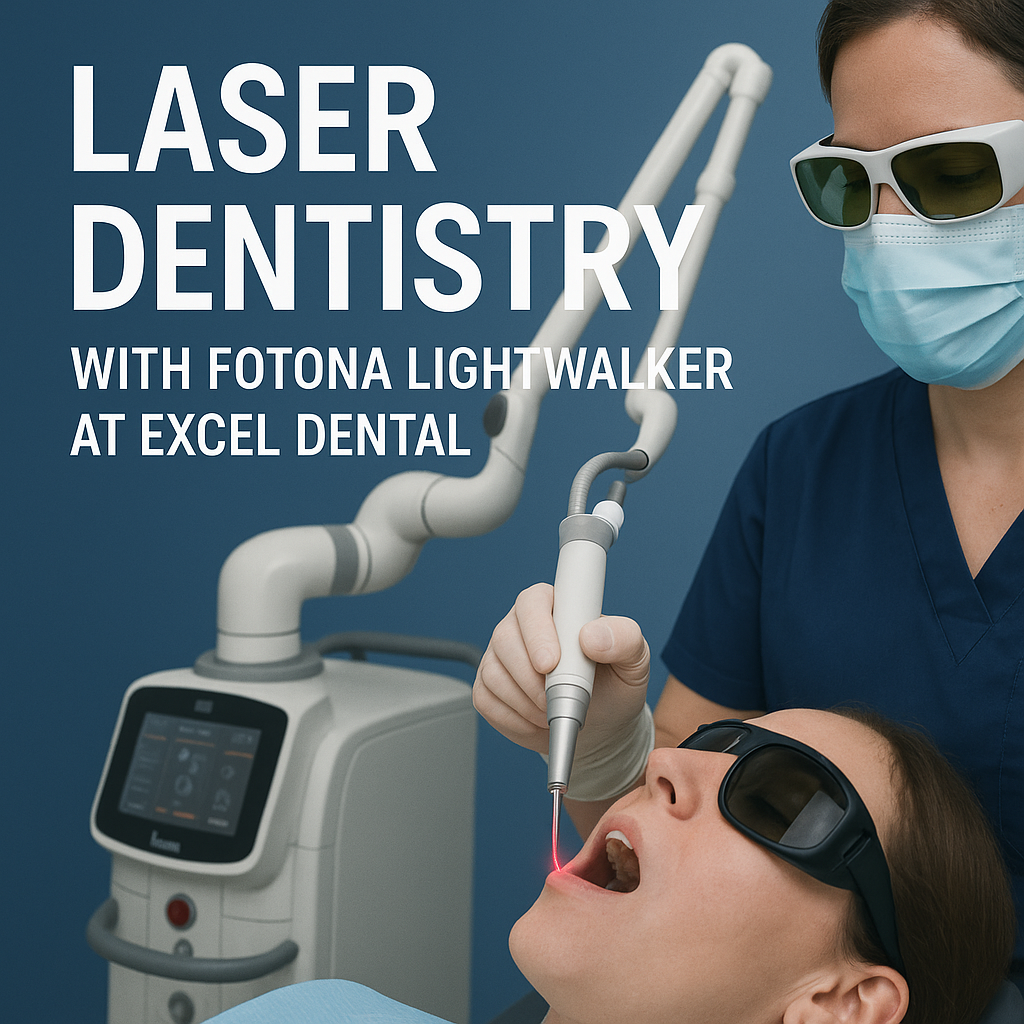
Laser Dentistry in Hamilton: Questions to Ask Before Treatment
Laser dentistry can be useful for some gum and soft-tissue problems, but “laser” is not a diagnosis or a guarantee of a better result. If you are trying to understand a proposed treatment, start with what problem the laser is meant to solve in your case and how it compares with standard care. For a plain-language overview of the technology, see our laser dentistry page.
Why patients are hearing more about laser dentistry
Lasers may be used for selected periodontal care, some soft-tissue procedures, or healing support after certain treatments. The evidence depends on the exact problem, the type of laser, and the protocol used. In some situations, research suggests only modest added benefit, so it is reasonable to ask whether the laser is truly adding value or simply replacing a standard step.
Questions to ask before treatment
- What problem is the laser meant to solve in my case?
Start with the diagnosis, not the device. Ask whether the goal is to treat gum disease, remove soft tissue, support healing, or something else. - Is the laser an adjunct to standard care or a substitute for it?
Some laser uses are add-ons. Others may be offered instead of conventional care. The answer should be clear before you agree to treatment. - What evidence supports this exact use, not laser dentistry in general?
Ask about the specific procedure, not a broad claim that lasers are always helpful. Evidence can vary a lot by indication. - What type of laser will be used?
Different lasers are used for different tasks. The type matters because benefits and limits are not the same across procedures. - Do the settings or protocol matter for the result?
For some laser applications, the settings are important. Research on laser photobiomodulation shows that parameters vary widely, so it is reasonable to ask what protocol is being used and why. - What benefit should I expect, and how soon should it be noticeable?
Ask for a practical answer. For example: less bleeding, less swelling, easier healing, or better gum measurements. Also ask when those changes should be checked. - How will success be measured?
A good plan should include a way to judge whether treatment helped. That may be based on symptoms, tissue healing, or exam findings. - What are the reasonable alternatives?
Ask about conventional treatment, including what happens if the laser is not used. In some cases, standard periodontal therapy or soft-tissue surgery may still be the most appropriate option. - What are the risks, limits, likely discomfort, aftercare, and cost?
Consent should include benefits, risks, alternatives, no-treatment options, and costs. If the explanation stays vague, ask for a simpler comparison before deciding.
What a good consent conversation should cover
Ontario consent standards expect a clear explanation of the proposed treatment, the main risks and benefits, alternatives, and what may happen if you choose not to treat now. For laser care, that means understanding whether the laser is being used for gum treatment, soft-tissue surgery, or healing support—and whether it is meant to replace something you would otherwise receive with conventional care.
For periodontal treatment, recent research suggests laser-assisted care may have only modest added benefit in some situations, and the protocols are not standardized across studies. That is why it is reasonable to ask whether the proposed laser step is essential, optional, or simply a preference of the office.
When to pause and ask for more explanation
- The answer is mostly marketing language and not a specific treatment plan.
- The laser is described as a solution for every gum or soft-tissue problem without a diagnosis-specific explanation.
- You are not told what standard treatment is being compared.
- The expected benefit is unclear, or the time frame sounds unrealistic.
- You do not know what would happen if you chose conventional care instead.
For Hamilton patients, Excel Dental can review gum and soft-tissue options and explain whether laser use is being proposed as the main treatment or as an add-on. If you would like the plan explained in plain language, you can book a visit at our Hamilton office.
Key sources
- RCDSO consent guidance for dentists
- Canadian Dental Association question checklist
- Recent review of dental laser parameters
This article is for general education only and does not replace personalized advice, diagnosis, or treatment from a licensed dentist.